
Quantum Technology: The Future of Computing and Science
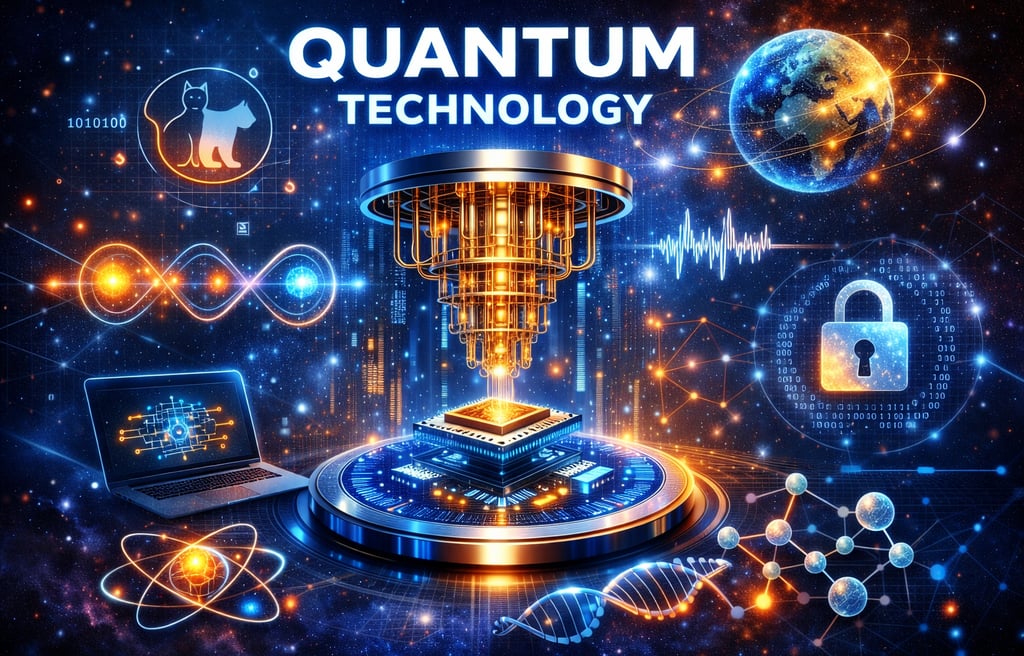
Quantum technology is one of the most exciting and revolutionary fields in modern science. It has the potential to transform industries, redefine computing, and solve problems that are currently impossible for classical systems. At its core, quantum technology is built on the principles of quantum physics and quantum science, which explore how matter and energy behave at the smallest scales.
Smart Village computer hub (Help of AI)
2/22/20262 min read
My post content
What is Quantum Physics?
Quantum physics is a branch of science that studies the behavior of particles at the atomic and subatomic levels. Unlike classical physics, where objects follow predictable paths, quantum physics introduces concepts like:
Superposition (particles can exist in multiple states at once)
Entanglement (particles can be connected across distances)
Uncertainty (you cannot know everything about a particle at the same time)
These principles form the foundation of all quantum technologies.
Understanding Quantum Science
Quantum science is a broader field that includes quantum physics and applies its principles to real-world applications. It combines physics, mathematics, and computer science to develop new technologies such as:
Quantum communication (ultra-secure data transfer)
Quantum sensors (highly precise measurement devices)
Quantum computing (next-generation computing systems)
Quantum science is not just theoretical—it is actively shaping the future of technology.
What is a Quantum Computer?
A quantum computer is a new type of computer that uses quantum bits, or qubits, instead of traditional binary bits (0 and 1). Unlike classical computers, which process information linearly, quantum computers can process multiple possibilities at the same time.
Key Features of Quantum Computers:
Superposition: A qubit can be both 0 and 1 simultaneously
Entanglement: Qubits can be interconnected, increasing processing power
Parallelism: Ability to solve complex problems much faster than classical computers
Because of these features, quantum computers can potentially revolutionize fields such as:
Cryptography and cybersecurity
Drug discovery and healthcare
Artificial intelligence and machine learning
Financial modeling and optimization
Why Quantum Technology Matters
Quantum technology is important because it can solve problems that are currently beyond the reach of traditional computers. For example:
Breaking complex encryption systems
Simulating molecular structures for new medicines
Optimizing large-scale systems like traffic or supply chains
Governments and companies around the world are investing heavily in quantum research, making it one of the most promising technologies of the 21st century.
Challenges in Quantum Technology
Despite its potential, quantum technology is still in its early stages. Some of the major challenges include:
Maintaining qubit stability (quantum systems are very sensitive)
High cost of development and infrastructure
Limited number of practical applications currently
However, continuous research is rapidly overcoming these barriers.
The Future of Quantum Technology
The future of quantum technology looks incredibly promising. As advancements continue, we can expect:
More powerful and stable quantum computers
Integration of quantum systems into everyday technology
Breakthroughs in science, medicine, and engineering
Quantum technology is not just a scientific breakthrough—it is a gateway to a new era of innovation.
Conclusion
Quantum technology, powered by quantum physics and quantum science, is set to transform the world. The development of quantum computers marks a major step toward solving complex global challenges. Although still evolving, this field holds immense potential and will play a crucial role in shaping the future of technology.